Updated · 7 min read
How to Organize a Shared Kids Bedroom in a Small Space: 10 Renter-Friendly Picks
Product buttons open current options and prices at the shop. Nothing here is sponsored. How we pick.
This guide is for parents and caregivers fitting two kids, two beds, and all their stuff into one small rental bedroom. The picks below give each child a clear zone, take toys and clothes off the floor, and set up without drilling, so you get your deposit back when you move.
Before you buy anything, measure the room. Note the door swing, window and outlet locations, and the clearance under each bed. Ten minutes with a tape measure can save you a return.
1. Clear-pocket over-the-door organizer
The back of the door is free storage in a shared room. A clear-pocket organizer hangs on metal hooks and needs no tools. Split it down the middle so one child's shoes, hair accessories, or art supplies go on the left and the other's go on the right. The clear pockets let young kids see where things go. Before buying, check that your door closes with the hooks on it, since some solid-core rental doors fit tightly in the frame.
Best for: Shoes, small toys, and craft supplies that end up all over the floor
Typical price: $12–$25
See clear over-the-door organizers →
2. Rolling under-bed storage bins
Under the beds is usually the biggest unused space in a kids' room. Bins with wheels and lids slide out easily enough for kids to put things away themselves. Give each child the bins under their own bed, which cuts down on "that's mine" fights. Measure from the floor to the bottom of the bed frame first. Most bins need 6 to 7 inches, and you can add bed risers if yours is lower.
Best for: Off-season clothes, extra bedding, and toys in rotation
Typical price: $25–$50 for a set of 2
For outgrown sizes and swapping wardrobes between seasons, see our Seasonal Clothing Storage Ideas for Small Closets.
3. Low cube organizer used as a room divider
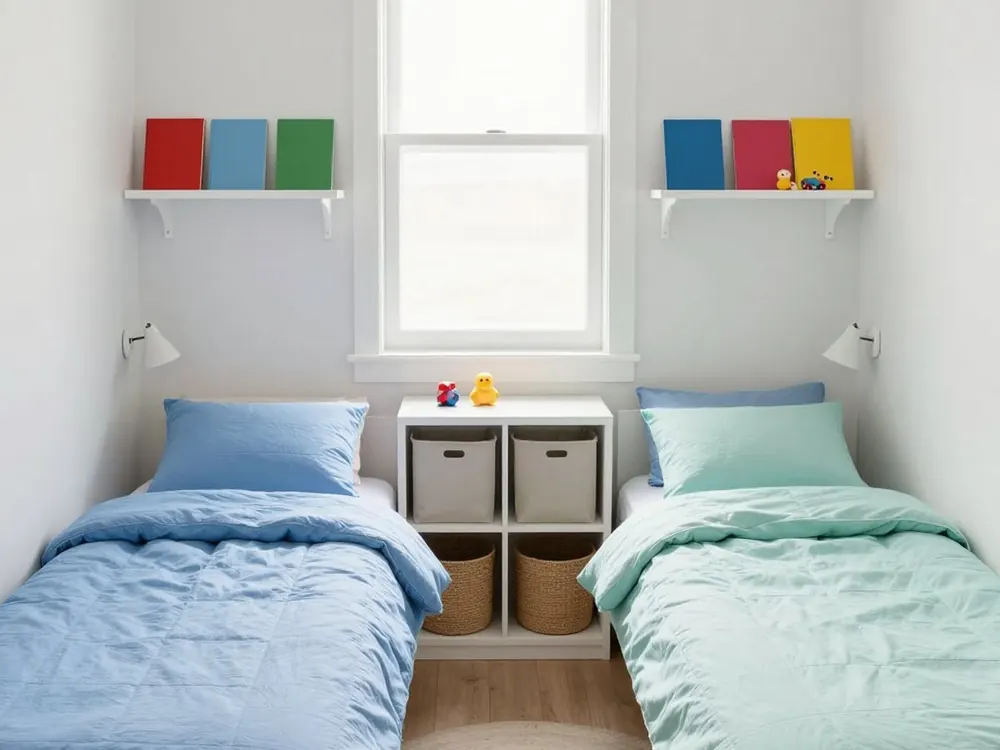
A 2x4 cube shelf stood on its long side between the beds works as storage and a divider at once. It stays low, so it doesn't block light from the window or make the room feel boxed in. Each child gets the cubes facing their side. Freestanding pieces don't need wall mounting, but if your younger child climbs, use the included anti-tip strap. Many landlords allow one small anchor hole, so ask first.
Best for: Separating beds while storing books and toys
Typical price: $50–$90
4. Color-coded fabric cube bins
Pair the cube shelf with fabric bins in two colors, one color for each child. Kids who can't read yet can still tell which bins are theirs, and cleanup goes faster when everything has an obvious home. Look for 11-inch or 13-inch bins depending on your shelf's cube size. Measure the opening before you order, because the two sizes aren't interchangeable.
Best for: Ending arguments over whose stuff is whose
Typical price: $15–$30 for a 6-pack
5. Tension-rod room divider curtain
If the kids want more privacy, especially with an age gap, a floor-to-ceiling tension pole or ceiling-height tension rod with a curtain splits the room without any holes. When the older child does homework while the younger one sleeps, the curtain also blocks light. Measure your ceiling height and choose a rod rated for that span. Blackout fabric is worth the small extra cost.
Best for: Kids with different bedtimes or ages
Typical price: $35–$80 (rod plus curtain)
See tension-rod room dividers →
6. Hanging closet doubler rod
Kids' clothes are short, so a single closet rod wastes about half the vertical space. A doubler hangs from your existing rod and adds a second one below it, at a height kids can reach. Give one child the top rod and the other the bottom, or split each rod down the middle. Check the weight rating, which is often 30 to 50 lbs, and don't overload a flimsy rental closet rod.
Best for: Shared closets with only one hanging rod
Typical price: $12–$25
More closet layouts are in Small Bedroom Closet Organization Ideas That Actually Work.
7. Kids' slim velvet hangers in two colors
Slim velvet hangers take up noticeably less rod space than plastic tube hangers or padded ones, and clothes don't slide off. Buy children's sizes, about 11 to 14 inches, in two colors so each kid's clothes are easy to spot. This one change can make a crowded shared closet usable again.
Best for: Getting more clothes into a shared closet
Typical price: $18–$30 for a 30–50 pack
8. Bedside caddy
Most shared kids' rooms have no space for two nightstands. A bedside caddy tucks between the mattress and the frame and holds a water bottle, a book, glasses, or a favorite stuffed animal. It needs no tools and takes up no floor space. Look for one with a long insert flap so it stays put when a restless kid rolls over.
Best for: Rooms with no space for nightstands
Typical price: $10–$20
For more ideas, see Nightstand Alternatives for Tiny Bedrooms That Actually Work.
9. Clear stackable bins with lids for toy rotation
Keep about a third of the toys in the room and pack the rest away. Every month or two, swap a bin, and the kids get "new" toys without you buying anything. Clear bins let you see what's inside without opening them, and they stack on a closet shelf or in another room. Put a picture label on each one for younger kids.
Best for: Toy rotation and taming toy overload
Typical price: $25–$50 for a set of 4–6
10. Clip-on LED reading lights
Siblings rarely go to sleep at the same time. A clip-on light for each bed lets one child read while the other sleeps, so you don't need two lamps or a lamp on the floor. Clip it to the headboard, the bunk rail, or the cube shelf. Rechargeable USB models avoid cords trailing across the floor, and warm, dimmable light is better at bedtime.
Best for: Different bedtimes in the same room
Typical price: $15–$30
How to choose
- Measure under-bed clearance. Measure from the floor to the lowest point of the frame. Bins should leave about half an inch of space so they roll freely.
- Measure ceiling height before buying a loft or bunk bed. Leave at least 30 inches between the top mattress and the ceiling so a child can sit up without hitting their head.
- Check the door. Make sure over-the-door hooks don't stop the door from latching, and keep the door swing clear of furniture.
- Know your weight limits. Closet doublers, tension rods, and adhesive hooks all list a maximum load. Stay under it, especially with heavy kids' coats and backpacks.
- Choose tension over adhesive on textured or freshly painted walls. Adhesive strips can peel paint. If you do use them, wait at least a week after painting and remove them slowly by pulling the tab straight down.
- Plan for tipping. Kids climb furniture. Choose low, wide pieces, or ask your landlord about anti-tip anchors in writing.
- Pick one color per child, and stick with it across bins, hangers, and hooks. A system the kids understand is one they'll keep up.
If the room has no closet at all, our guide on How to Organize a Bedroom With No Closet covers freestanding wardrobe options.
FAQ
What's the best layout for a small shared kids' bedroom?
Place the beds against opposite walls, or in an L-shape in one corner, to keep the center of the floor open for play. If your ceiling is high enough, a bunk or loft bed frees up the most floor space.
How do I organize a shared room when the kids are different ages?
Give the older child higher shelves and a quiet corner for homework. Keep the younger child's toys in low bins they can reach. A divider curtain and separate reading lights help with different bedtimes.
What storage works if I can't drill into the walls?
Over-the-door organizers, tension rods, freestanding cube shelves, rolling under-bed bins, closet doublers, and removable adhesive hooks all go up and come down without leaving holes.