Updated · 7 min read
Pot and Pan Storage Ideas for Small Kitchens: 10 Renter-Safe Buys That Stop the Cookware Avalanche
Product buttons open current options and prices at the shop. Nothing here is sponsored. How we pick.
If your whole cookware collection lives in one or two lower cabinets, you know what happens: you need the skillet at the bottom and everything on top slides out onto the floor. This roundup is for renters who can't drill, can't add cabinets, and still want to grab a pan without a fight. Every pick works inside the cabinets you already have, and several help with the extra roasting pans and casserole dishes that show up between Thanksgiving and New Year.
1. Adjustable vertical pan rack
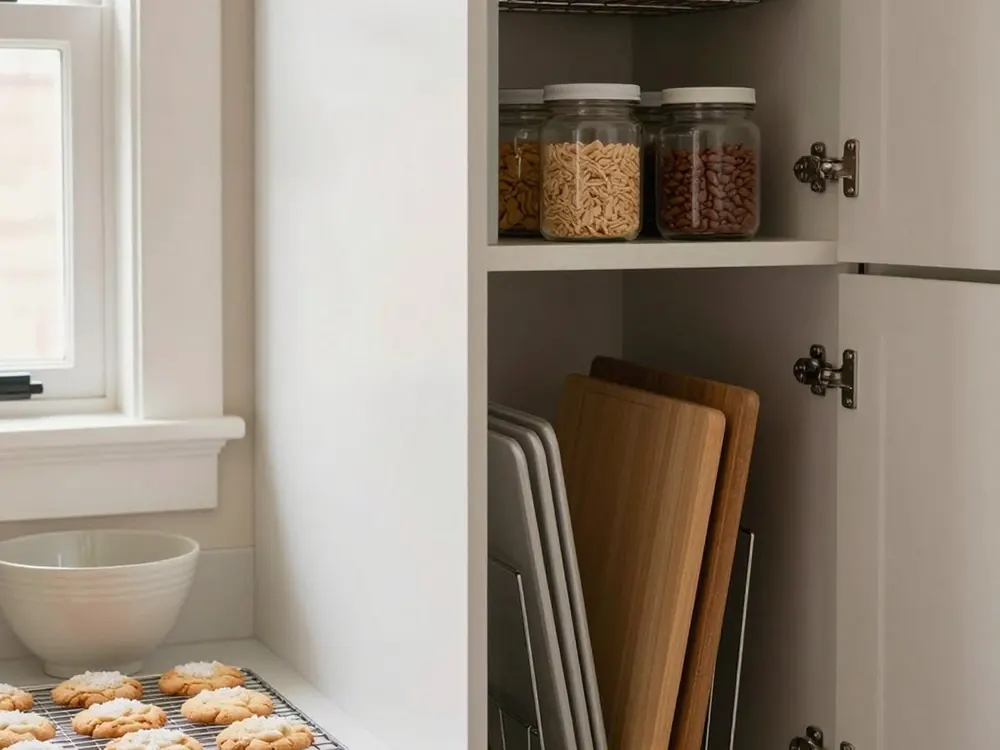
A vertical rack stores skillets, sheet pans and cutting boards on edge, like files, so you can slide one out without moving the rest. Choose one with movable dividers so you can space them for a deep sauté pan or a thin griddle. Measure your cabinet's height first. Most racks stand 9 to 12 inches tall, and pans stick up above that, so leave about 4 inches of clearance under the shelf.
Best for: Skillets, sheet pans and baking trays in a single base cabinet
Typical price: $15–$30
2. Multi-tier horizontal pan organizer
These racks hold each pan flat on its own wire shelf, which is easier on nonstick coatings than stacking. Five-tier versions fit a lot of pans into a narrow footprint, often under 10 inches wide. Many can stand horizontally or vertically, so you can set them up to fit a short cabinet or a tall one. Check the per-shelf weight rating before you load cast iron.
Best for: Protecting nonstick pans from scratches
Typical price: $18–$40
3. Freestanding pull-out cabinet basket
A sliding basket brings the back of a deep cabinet out to you, which is where pots go to be forgotten. Look for models that sit freely on the cabinet floor or attach with adhesive strips. Many attach with screws, so read the listing before you buy. Measure the inside width at the door opening, not the cabinet box. Hinges and the center stile can take 1 to 2 inches off it.
Best for: Deep base cabinets where pots get lost in the back
Typical price: $30–$65
See no-drill pull-out baskets →
4. Expandable pot lid organizer
Lids are usually what starts the avalanche. An expandable lid rack stands lids upright in slots, and many adjust from about 13 to 22 inches wide to fit your cabinet. YouCopia's StoreMore lid holder is a well-known expandable option, and generic versions do the same job. If you already have a jumble of container lids too, our guide to food container and Tupperware organization ideas covers that part.
Best for: Putting 6 to 10 mismatched lids in one place
Typical price: $12–$28
See expandable lid organizers →
5. Adhesive or over-door lid holder
The back of the cabinet door is free space. Over-the-door lid racks hook over the top of the door with no tools. Adhesive lid holders stick to the inside of the door and come off cleanly if you follow the removal directions. Close the door slowly after you install one. The lids need to clear the shelf edge and anything stored at the front of the cabinet.
Best for: Freeing up shelf space when your cabinet floor is already full
Typical price: $10–$25
See door-mounted lid holders →
6. Expandable under-sink shelf
If your sink cabinet is your second cookware cabinet, an expandable two-tier shelf adds a level that fits around the drain pipe. Look for adjustable or removable shelf panels so you can work around the P-trap and garbage disposal. Use it for lighter items like stockpot lids, colanders and a roasting rack, and keep heavy cast iron off the cabinet floor in case of leaks.
Best for: Turning the space around the plumbing into cookware storage
Typical price: $20–$40
See expandable under-sink shelves →
7. Stackable wire cabinet shelf
A simple wire helper shelf splits one tall stack into two short ones, so pots sit on the floor and pans sit on top. They usually come in 2-packs and stack or sit side by side. Measure the depth too. A 15-inch-deep shelf in a 24-inch cabinet leaves room at the back for a big stockpot. Look for these first if you're on a tight budget.
Best for: Separating pots from pans for under $25
Typical price: $15–$28 (2-pack)
See stackable cabinet shelves →
8. Felt pan protectors
If you have to stack pans, put a felt pad between each one. The pads stop scratches and stop the metal-on-metal sliding that makes stacks tip over. Get the size that matches your biggest pan, since one pad can cover smaller pans too. You can make a nested stack this way and still keep your nonstick coating.
Best for: Nesting pans safely when you can't fit a rack
Typical price: $8–$15
9. Tension rods for lids and sheet pans
Two short tension rods across a cabinet make an instant divider for lids, trays and cutting boards, with no holes in anything. Set one rod low and one higher toward the back, and you get a slot that holds lids at an angle. Get rods sized to your cabinet's inside width, usually the 12-to-20-inch range. This is the cheapest renter-safe fix on the list.
Best for: A next-to-free DIY lid and tray divider
Typical price: $8–$15 (2-pack)
10. Stackable cookware with detachable handles
If you're replacing worn-out pans anyway, sets with removable handles nest flat, so a whole set fits in about the space of one pot. T-fal's Ingenio line is the best-known example on Amazon US. Before you buy, check that the pans work with your stove, especially if your rental has an induction or glass-top range. This pick costs the most, but it frees the most space.
Best for: Renters replacing a mismatched set who want everything to fit in one cabinet
Typical price: $80–$180
How to choose
- Measure three things: the inside cabinet width at the door opening, the depth, and the height under any fixed shelf. Write them down before you buy anything, and keep about half an inch of wiggle room on each.
- Check weight limits: a 12-inch cast iron skillet weighs about 7 to 8 pounds. Wire racks and adhesive hooks list a maximum load, and you should stay well under it.
- Know your attachment type: freestanding and tension options leave no trace. Adhesive is fine on smooth, sealed cabinet doors, but it can peel paint or laminate if you pull it off fast. Stretch-release strips are the safest choice. Skip anything that says "screw-mount required" unless your lease allows it.
- Plan around the hinge: door hinges and the center post block the cabinet opening. A pull-out that's too wide won't come out past them.
- Store by how often you cook with it: keep the pan you use every night in front and at waist height. The holiday roasting pan can go in the back corner, under the sink or under the bed.
- Count before you buy: line up every pot, pan and lid on the counter. Get rid of duplicates first, and you may need one rack instead of three.
For more no-drill ideas for the rest of your kitchen, see our apartment kitchen storage hacks for small spaces. If your utensils and baking tools are spilling over too, our deep drawer organization ideas show how to fit more into one drawer.
FAQ
What's the best way to store pots and pans with no cabinet space?
Use your vertical space and the space that isn't in cabinets. Over-door racks, a rolling cart next to the fridge, or the oven drawer (if your range has a storage drawer rather than a warming drawer) can all hold cookware. Store holiday-only pieces outside the kitchen entirely.
Is it bad to stack nonstick pans?
Stacking bare nonstick pans scratches the coating over time. Put felt protectors between them, or use a tiered rack so each pan gets its own shelf.
Will adhesive organizers damage my rental cabinets?
They can if the surface is painted or peeling, or if you yank them off. Clean the spot with rubbing alcohol before you stick anything on, let the adhesive cure for the time the package says, and use stretch-release strips. When you move out, peel them off slowly and parallel to the surface.