Updated · 7 min read
Small Home Office Nook Ideas for Apartments: 10 Renter-Safe Buys That Fit a Tiny Corner
Product buttons open current options and prices at the shop. Nothing here is sponsored. How we pick.
If you work or study from a studio, a one-bedroom, or a shared apartment, you probably don't have a spare room to turn into an office. These picks help you fit a real workspace into a 3-by-4-foot corner without drilling, without breaking your lease, and without your desk taking over the place you also live in.
1. Compact Writing Desk (32–40 Inches Wide)
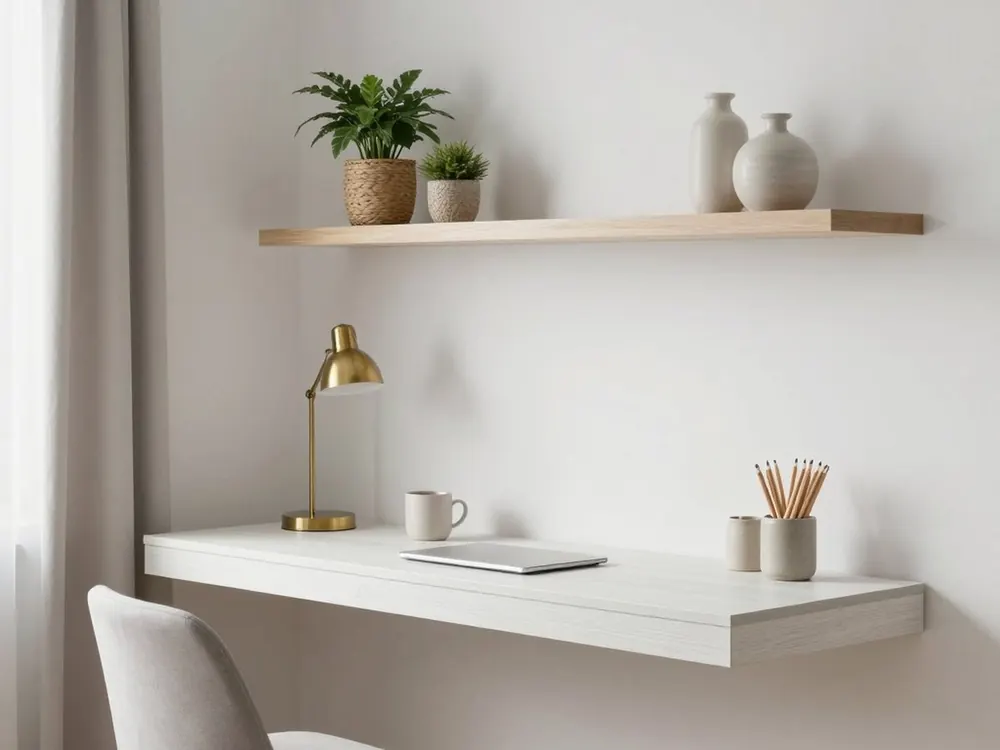
A full-size desk is usually 48 to 60 inches wide, which is far more than most nooks can spare. A slim writing desk 32 to 40 inches wide and 18 to 24 inches deep has room for a laptop or one monitor, a keyboard, and a notebook. If you want to write by hand next to your screen, aim for at least 36 inches. Pick one with a small drawer or a shelf underneath so you don't need a separate storage piece.
Best for: Alcoves, the wall space beside a window, or the end of a living room
Typical price: $60–$150
2. Small Corner Desk
Corners are the most wasted space in a small apartment, and a corner desk turns that space into work surface. An L-shaped or triangular desk gives you more surface while sticking out less into the room than a straight desk would. Measure both walls from the corner, and check for baseboard heaters or outlets before you order.
Best for: Bedrooms and studios where every straight wall is already in use
Typical price: $50–$130
3. Leaning Ladder Desk
A ladder desk leans against the wall, so you get a desk with shelves above it and no drilling. It uses vertical space, and on most models the whole thing takes up less than 2 feet of floor depth. Most come with a small anti-tip strap. If your lease doesn't allow even one small screw, place it in a low-traffic corner and keep heavy items on the lower shelves.
Best for: Renters who want desk space and storage in one footprint
Typical price: $80–$180
4. Armless Mesh Office Chair
A dining chair is fine for an hour, but if you work several hours a day, your back needs a real office chair. Armless chairs slide all the way under a small desk, so the chair doesn't stick out into your walkway when you're done. Mesh backs look lighter than bulky padded chairs and keep you cooler in summer. Look for adjustable seat height and some lumbar support. Gray or black blends into a shared living space better than bright colors.
Best for: Any nook where the chair has to tuck away completely
Typical price: $60–$150
5. Clamp-On LED Desk Lamp
Clamp-on lamps leave your whole desktop free, which matters on a 20-inch-deep desk. Put the lamp to the side of your screen, not behind it, to avoid shadows and glare. Choose one with adjustable color temperature. A neutral setting around 4000K works well for focused work, and a warmer setting is easier on your eyes at night. LEDs also use less electricity, which helps when you pay your own utilities.
Best for: Nooks with little natural light, and evening work
Typical price: $25–$60
6. Monitor Riser With Storage
A monitor riser brings your screen closer to eye level, which helps your neck. It also creates a slot underneath where your keyboard, notebook, or phone can go when you're not using them. On a shallow desk, that slot works like a second shelf. If your desk has a sturdy edge, a clamp-on monitor arm frees up even more space. Check the arm's clamp range against your desk's thickness before you buy.
Best for: Laptop-plus-monitor setups on small desks
Typical price: $20–$45 (riser), $30–$70 (single monitor arm)
7. Under-Desk Cable Tray and Surge Protector
Cords are what make a small nook look messy. An under-desk cable tray that clamps onto the desk edge holds your surge protector and spare cable length off the floor, with no screws in your desk or the wall. Bundle the remaining cords with reusable cable sleeves or clips. Switching to a wireless mouse and keyboard cuts down the clutter even more.
Best for: Anyone whose desk sits in view of the living area
Typical price: $20–$40 (tray), $15–$30 (surge protector)
8. Desktop Pegboard Organizer
Pegboards are great for storage, but most need to be screwed into the wall. A freestanding desktop pegboard sits on the back edge of your desk and holds small shelves, hooks, and cups for pens, headphones, and chargers. You get vertical storage within arm's reach and leave no holes behind. For more ideas for small desks, see Dorm Desk Organization Ideas That Actually Work. They work just as well outside a dorm.
Best for: Keeping supplies visible without wall holes
Typical price: $25–$50
9. Folding Room Divider or Tension Rod Curtain
If your desk is in your bedroom or in view of the couch, a visual barrier helps you switch off at the end of the day. It also hides your desk from video calls and from guests. A folding screen sets up in seconds and folds flat behind a door. In an alcove, a tension rod with a heavy curtain closes off the nook without drilling and also softens some noise. For full-room planning, see Studio Apartment Layout Ideas for 400 Sq Ft: 10 Smart Plans.
Best for: Bedroom corners and open studios
Typical price: $50–$120 (divider), $20–$45 (tension rod and curtain)
10. Rolling Drawer Cart
A narrow rolling cart with three or four drawers fits under or beside your desk and holds files, paper, and chargers. If your desk has no drawers, this is the easiest way to add some. When guests come over, roll it into a closet. Measure the height under your desk first. Many carts are 26 to 28 inches tall, and most desks have about 28 inches of clearance. For more ways to hide work clutter, see Hidden Storage Solutions for Studio Apartments: 9 Renter-Safe Buys That Hide the Clutter.
Best for: Paperwork and supplies in a desk without drawers
Typical price: $30–$80
How to choose
- Measure the full nook, not just the wall. Write down width, depth, and height. Leave about 30 to 36 inches behind the desk so you can pull the chair out and stand up.
- Check where your outlets are. A desk in front of an outlet means reaching behind it every time. A desk 10 feet from one means a long extension cord crossing the floor.
- Mind the window. Put your desk at a right angle to the window instead of facing it or with it behind you. You get daylight without monitor glare or a backlit face on calls.
- Read clamp specs. Clamp lamps, monitor arms, and cable trays only fit desk tops within a set thickness range, often up to about 2 to 3 inches. Check your desk's edge, and make sure it isn't glass or thin particleboard.
- Know your lease. If anchoring furniture to the wall isn't allowed, choose freestanding, leaning, or tension-rod options. If you use adhesive hooks or strips, test them on a hidden spot first. Some can pull off paint.
- Respect weight limits. Keep shelves and risers under their listed load, especially leaning pieces.
- Think about noise. A rug under your desk, a curtain behind your chair, or a filled bookshelf between you and a roommate all absorb sound. Noise-canceling headphones handle the rest.
FAQ
What's the smallest desk that actually works for full-time remote work?
Around 30 inches wide works if you only use a laptop. For a laptop plus an external monitor, or room to write by hand, 36 inches is more comfortable. Depth of 20 inches or more keeps a monitor at a comfortable distance.
Can I put my office nook in my bedroom?
Yes. Face the desk away from the bed if you can, and use a divider or curtain so you can close off "work" at night. Separating them makes it easier to switch off and sleep.
How do I add an office nook without drilling?
Use a freestanding or leaning desk, clamp-on lamps and cable trays, a desktop pegboard instead of a wall-mounted one, and a tension rod curtain to close off the space. Everything comes out when you move.