Updated · 7 min read
Small Kitchen Trash and Recycling Solutions for Rentals: 9 No-Drill Buys That Actually Fit
Product buttons open current options and prices at the shop. Nothing here is sponsored. How we pick.
If your rental kitchen has room for one trash can and your city wants you to recycle too, this guide is for you. These picks are sized for studios, galley kitchens, and dorms. None of them need drilling, so you can sort trash, recycling, and even compost without giving up floor space or your security deposit.
1. Slim dual-compartment step can
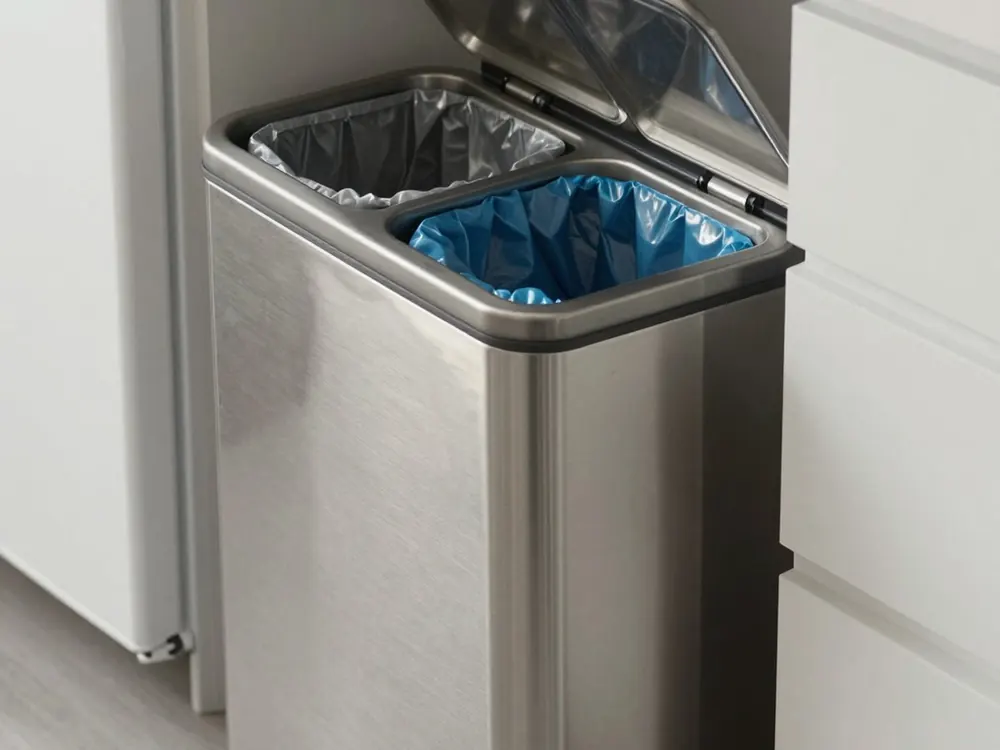
A dual-compartment can puts trash and recycling in one footprint, so you need one spot instead of two. The simplehuman dual compartment rectangular step can is the best-known version. Cheaper generic models use the same idea: two inner buckets side by side or front to back, opened by a foot pedal so you don't touch a dirty lid with full hands. Before you buy, check the depth. You want 20 inches or less so it doesn't stick out into a narrow walkway. Also check that the lid can open fully under your counter overhang.
Best for: Kitchens with one open floor spot near the prep area
Typical price: $45–$90 generic; $120–$200 for simplehuman
See dual trash and recycling cans →
2. Narrow "gap" trash can for beside the fridge
Most rentals have a dead strip of space between the fridge and the wall or the counter end. A slim can that's 8 to 10 inches wide and 10 to 13 gallons fits there and uses height instead of floor space. Choose a model with a flat back so it sits flush against the wall. Look for wheels or a pull handle so you can slide it out to empty it. Measure the gap at the floor, because baseboards and fridge feet can take an inch.
Best for: Studios and galley kitchens with a leftover 9–12 inch gap
Typical price: $25–$60
3. Stackable front-opening recycling bins
Stackable bins with flip-up front lids let you sort recycling vertically, two or three bins tall, in about the space of one small can. You can drop cans in the top bin and paper in the bottom one without unstacking anything. If your city sorts recycling by material, this works better than a single big bin. Put the stack in a corner or a closet and keep the heaviest material, usually glass, in the bottom bin.
Best for: Renters whose city requires sorted recycling
Typical price: $30–$70 for a set of 2–3
See stackable recycling bins →
4. Over-the-cabinet-door hanging trash can
A small hanging bin hooks over a cabinet door, usually the one under the sink. It takes up no floor or counter space. It's sized for 1–2 gallons, so use it for food scraps while you cook or as a dedicated small-recycling catch. Before you buy, check two things: whether the hooks fit your door thickness (most fit up to about 3/4 inch), and whether the door still closes with the bin hanging on it.
Best for: Dorms, tiny studios, and catching scraps while you cook
Typical price: $12–$25
5. Freestanding pull-out bin for under the sink
Under the sink can hold a lot of trash space if the bin slides out instead of getting jammed behind the pipes. Get a freestanding sliding frame with a bin: it sits on the cabinet floor and needs no screws. Skip the models that bolt into the cabinet base, because those aren't renter-safe. Measure from the cabinet floor to the bottom of the P-trap (the U-shaped pipe) before you shop, and use a waterproof liner or tray underneath in case of leaks. If you're also clearing out cleaning supplies to make room, How to Organize Kitchen Cabinets in a Small Kitchen: 10 Renter-Safe Buys That Actually Fit has ideas for where to move them.
Best for: Hiding trash completely in an open-concept studio
Typical price: $25–$55
See under-sink pull-out bins →
6. Over-the-door pantry organizer for recycling
If you have a pantry or closet door near the kitchen, an over-the-door rack with deep baskets can hold rinsed cans, bottles, and flattened boxes off the floor. It hangs on hooks, so you don't need tools or landlord permission. Choose deep, solid-bottom baskets over shallow wire shelves so nothing falls through. Check the weight limit before you load glass. For more ways to use that same door, see Fall Pantry Restock and Organization Ideas for Renters: 10 No-Drill Buys That Fit Small Kitchens.
Best for: Renters with a pantry or closet door near the kitchen
Typical price: $25–$60
7. Collapsible recycling bags or pop-up bins
Recycling only piles up between pickups. A collapsible bin or a set of sturdy sorting bags can live in the kitchen during the week and fold flat once you've emptied it. Bags with handles double as carriers to the building's recycling room, which saves you a trip. Choose a water-resistant lining so a damp can doesn't soak through.
Best for: Apartments where you carry recycling down to a shared room
Typical price: $15–$35 for a set
See collapsible recycling bags →
8. Plastic bag and liner dispenser
A bag dispenser keeps spare liners and grocery bags in one slim tube instead of a messy pile under the sink. Most attach with adhesive strips or hang over a cabinet door. Mount it inside the door, near your bin, so a fresh liner is right there when you take out the trash. If you use adhesive, choose a removable strip rated for the weight and test it on a hidden spot first.
Best for: Anyone with a bag-of-bags situation under the sink
Typical price: $10–$20
9. Countertop compost bin with charcoal filter
Food scraps cause most trash smells, so moving them into a small sealed compost bin keeps your main can fresher for longer between emptyings. Choose a 1–1.5 gallon bin with a charcoal filter in the lid and a smooth inside that's easy to rinse. It should take up about as much counter space as a canister. This only makes sense if your city has compost pickup or a drop-off spot nearby, so check that first.
Best for: Renters with compost pickup or a farmers market drop-off
Typical price: $20–$40
How to choose
- Measure three dimensions, then add the lid. Measure the width, depth, and height of your spot. Then check lid clearance: step cans and flip lids open upward and can hit a counter overhang or a low cabinet.
- Measure from the floor to the P-trap before buying anything for under the sink. Pipes and garbage disposals eat up more room than you'd expect.
- Check door thickness and clearance for over-door and over-cabinet products. If the hooks are too thick, the door won't close.
- Choose hooks and freestanding pieces first, adhesive second. Over-door hooks and tension or freestanding frames leave no marks. Adhesive strips work, but they can peel paint on cheap rental finishes, so read your lease, use removable strips, and stay under the weight rating.
- Look up the bag size. Some premium cans need custom-fit liners, which cost more over time. Standard 13-gallon or 4-gallon bags are cheaper and easier to find.
- Match your city's rules. Single-stream recycling means one recycling bin is enough. If your city sorts by material, get a stackable or multi-bin setup.
- Think about pets and roommates. Dogs can get into open-top and swing-lid bins, so choose a step or locking lid. Shared kitchens do better with labeled bins (removable vinyl labels work).
Looking for more space-savers? Apartment Kitchen Storage Hacks for Small Spaces: 10 Renter-Safe Buys That Actually Fit covers the rest of the room.
FAQ
What size trash can do I need for a one-bedroom apartment?
Most people living alone do fine with 9–13 gallons, and couples usually want 13–16. Track how often you empty your current bin: if it overflows before trash day, size up; if it starts to smell before it's full, size down.
Can I just use one bin for trash and recycling?
Not really. Food and liquids contaminate recyclables, and contaminated loads often end up in the landfill anyway. A dual-compartment can or a small hanging recycling bin keeps them separate without taking up much extra space.
How do I stop a small trash can from smelling?
Empty it more often. Keep food scraps out by using a compost bin or a sealed bag, rinse containers before you recycle them, and sprinkle baking soda in the bottom of the can under the liner.