Updated · 6 min read
Spice Organization Ideas for Small Kitchens: 9 Renter-Safe Buys That Actually Fit
Product buttons open current options and prices at the shop. Nothing here is sponsored. How we pick.
If your spices live in a jumbled pile you have to dig through every time you cook, this guide is for you. It's written for renters in studios, small apartments, and dorms who can't drill holes or remodel. Every pick below sits on a shelf you already have, slides into a drawer, or attaches without tools, so you can find the cumin in five seconds and get your deposit back.
Before you buy anything, pull out every jar. Toss anything that's faded, clumped, or has lost its smell (ground spices usually fade after 2–3 years), and combine duplicates. Then count what's left. That number tells you how much storage you need.
1. Expandable 3-Tier Spice Shelf Riser
This is the easiest fix for a deep, dark cabinet. A stepped riser lifts the back rows so every label is visible. Expandable models usually stretch from about 12 to 24 inches wide, which lets one riser fit a narrow upper cabinet and still work after you move. Measure your cabinet's usable depth first. Most risers need 8–10 inches, and standard 4 oz jars need about 5 inches of height per tier.
Best for: Upper cabinets where jars disappear in the back row
Typical price: $15–$30
See expandable spice shelf risers →
2. In-Drawer Tiered Spice Insert
If you have a spare shallow drawer, an angled insert holds jars on their sides with the labels facing up, so you can read everything at a glance. Look for expandable or stackable trays that adjust to your drawer width. Check the inside drawer height before you order: most inserts need about 2.5–3 inches of clearance for standard jars. For bigger drawers, see Deep Drawer Organization Ideas for Your Kitchen: 9 Renter-Safe Buys That Actually Fit.
Best for: Cooks who want spices out of sight but easy to read
Typical price: $15–$35
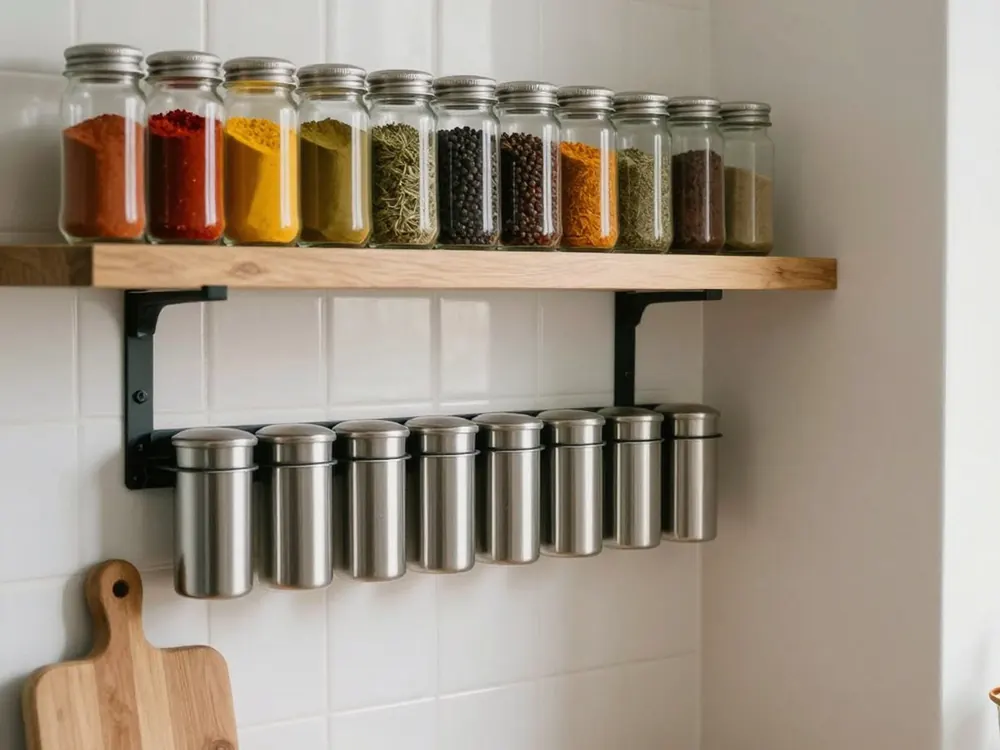
3. Magnetic Spice Tins for the Fridge
These tins use zero cabinet space. Round tins with clear lids and magnetic bases stick to the side of your fridge, so you can read the contents through the lid. Do a magnet test first, because many stainless-steel fridges aren't magnetic. You also need at least an inch of clearance between the fridge and the wall or cabinet. Keep them on the side farthest from the stove to avoid heat.
Best for: Studios with zero spare cabinet or drawer space
Typical price: $20–$40 for a set of 12–24 tins
4. Two-Tier Lazy Susan Turntable
A turntable puts the whole collection within one spin, so you never knock over three jars to get to the paprika. A two-tier version doubles the capacity in the same footprint. A 10-inch diameter fits most standard upper cabinets, and you can go to 12 inches if your cabinet is deeper. Pick one with a raised lip so jars don't fly off when you spin it.
Best for: Corner cabinets and awkward deep shelves
Typical price: $12–$30
5. Slim Pull-Out Cabinet Spice Organizer
This narrow, freestanding rack slides forward on built-in rails, like a drawer you don't have to install. It sits on the cabinet floor with no screws, and it puts the space in a tall, skinny cabinet to work. Most are 4–6 inches wide, so measure your cabinet opening, not just the interior, because hinges and face frames eat up width.
Best for: Narrow lower cabinets next to the stove or sink
Typical price: $25–$50
See pull-out spice organizers →
6. Over-the-Cabinet-Door Spice Rack
The inside of a cabinet door is free storage. A rack that hooks over the top of the door goes up without drilling or adhesive. Measure your door thickness (hooks usually fit about ¾ inch) and check that the shelf behind the door leaves room for the rack plus the jars when the door closes. Many racks need 3–4 inches of clearance. Put light, everyday spices here and keep heavy bottles off the door.
Best for: Renters who don't want any adhesive on cabinet surfaces
Typical price: $15–$30
7. Matching Square Glass Spice Jars With Labels
Uniform jars save more space than you'd expect. Square jars pack edge to edge with no wasted gaps, and identical sizes stack evenly on risers and in drawer inserts. Look for 4 oz jars with shaker lids and preprinted or blank labels. Sets of 24–36 are common. This is also when you finally decant those bulky grocery-store bottles.
Best for: Anyone whose collection is a mix of bottle shapes and sizes
Typical price: $20–$45 for a 24–36 jar set
8. Slim Rolling Cart for the Fridge Gap
That 5–7 inch gap between your fridge and the wall or counter can hold a whole spice collection. A slim rolling cart slides in and out on casters and needs no installation, and the narrowest models fit gaps around 5 inches wide. Measure the gap's width, depth, and height, then subtract half an inch so it slides smoothly. If your cart has room left over, it works for oils and vinegars too.
Best for: Galley kitchens and studios with a dead gap beside the fridge
Typical price: $25–$50
9. Clear Bins for Seasoning Packets
Taco mixes, gravy packets, and bouillon cubes slide around and end up everywhere. A couple of small clear bins with front handles keep them filed upright, like index cards, on a pantry shelf or in a cabinet. Pick bins about 4–6 inches wide so packets stand up instead of slumping over. If your pantry needs a bigger reset, start with Fall Pantry Restock and Organization Ideas for Renters: 10 No-Drill Buys That Fit Small Kitchens.
Best for: Packet-heavy cooks and meal-kit leftovers
Typical price: $12–$25 for a set
How to choose
- Count first, then buy. After your audit, count your jars. A 3-tier riser holds roughly 15–24 jars, a drawer insert around 18–24, and a magnetic tin set whatever number it comes in. Buy for your count plus a few extra slots.
- Measure three ways. Measure width, depth, and height for cabinets, and do it with the door open so you catch hinges and face frames. For drawers, measure the inside height. For gaps, measure all three dimensions and subtract half an inch.
- Pick the location before the product. Spices last longest somewhere cool, dark, and dry. Skip the shelf right above the stove and any sunny windowsill, even if it looks great on Pinterest.
- Decide between adhesive, tension, and freestanding. Freestanding options (risers, turntables, pull-outs, carts) carry no risk to your deposit. Over-door racks are the next safest. If you use adhesive, choose removable strips, follow the weight rating, and test on a hidden spot first, because some cabinet finishes peel.
- Respect weight limits. A full 4 oz glass jar weighs roughly 7–10 oz, so 12 jars on a door rack can top 6 pounds. Check the rated capacity and keep heavy bottles on shelves.
- Standardize jars before you buy racks. If you're switching to matching jars, buy them first and size your organizer around them.
For more ways to use every inch of your cabinets, see How to Organize Kitchen Cabinets in a Small Kitchen: 10 Renter-Safe Buys That Actually Fit.
FAQ
How do I organize spices if I can't drill holes?
Use freestanding pieces: shelf risers, lazy Susans, pull-out cabinet racks, drawer inserts, and slim rolling carts. Over-the-door racks and magnetic tins on the fridge also need no tools or hardware.
Is it okay to store spices above the stove?
It's convenient, but heat and steam make spices go stale faster. Keep a small "daily five" (salt, pepper, and your top three) near the stove if you want, and store everything else in a cooler cabinet or drawer.
Should I label with purchase dates?
Yes. Put the spice name on the front or lid, wherever you'll see it in your setup, and write the month and year you opened it on the bottom. That way you know when to replace it instead of guessing.