Updated · 7 min read
Small Kitchen Counter Organization Ideas: 9 Renter-Safe Buys That Actually Fit
Product buttons open current options and prices at the shop. Nothing here is sponsored. How we pick.
If your counter currently holds the toaster, the mail, three bottles of olive oil, and a dish rack that eats half your prep space, this guide is for you. These small kitchen counter organization ideas focus on cheap, no-drill products that fit tight rental kitchens and move with you when your lease ends. Each pick either adds a level of storage or groups items so you get your cutting-board space back.
Before you buy anything, clear your counters completely and sort everything into three piles: things you use daily, things you use occasionally, and things that don't belong in the kitchen at all. Only the daily pile goes back on the counter. Most people find this step frees up half the surface. The products below are for whatever still has to stay out.
1. Two-Tier Corner Shelf
Corners are the most wasted spot on a small counter because they're too deep to reach easily. A two-tier corner shelf (triangular or L-shaped) doubles that footprint for spices, small jars, or mugs, and it sits on the counter with no drilling. Measure the space from the back corner to where your upper cabinets start, and leave at least 2 inches above the top tier so you can lift items out.
Best for: Spices, small jars, and mugs in a dead corner
Typical price: $15–$35
2. Turntable (Lazy Susan) for Oils and Sauces
A 10- to 12-inch turntable next to the stove keeps cooking oils, vinegar, and hot sauce in one spot, and you can spin it to grab the bottle in the back. Get one with a raised lip so bottles don't slide off when you spin it. A clear or bamboo one is easier to wipe down than wire after oil drips.
Best for: Bottles that live next to the stove
Typical price: $10–$25
3. Expandable Tiered Spice Riser
If your spices are a pile of identical jars, a stair-step riser that holds three rows lets you read every label at once. Look for an expandable version (often around 13 to 25 inches wide) so it fits the gap between your stove and the wall, or between the coffee maker and the backsplash. A riser also moves easily into a cabinet later if you get more cabinet space.
Best for: Spice collections with no drawer or cabinet to live in
Typical price: $12–$25
4. Over-the-Sink Roll-Up Drying Rack
A full-size dish rack can take up 2 square feet of counter. A roll-up rack made of silicone-coated steel rods lies across the sink, dries dishes and produce, and rolls up into a drawer when you're done. Measure the inside width of your sink first. Most racks are about 17 to 20 inches long and need a rim on both sides to rest on. If you have a deep single-basin sink, a telescoping over-sink rack with legs is a better choice.
Best for: Studios with no room for a permanent dish rack
Typical price: $12–$30
5. Freestanding Magnetic Knife Block
A wall-mounted magnetic strip needs screws, and adhesive versions can fail under heavy knives. A freestanding magnetic block (usually wood or acrylic with magnets inside) holds knives on both faces, takes up less space than a slotted block, and works with knives of any width. It also stands upright, so its footprint is roughly the size of a paperback book.
Best for: Renters who want knives out of the drawer with no wall holes
Typical price: $25–$50
6. Utensil Crock with Dividers
Keep only your five or six most-used tools (spatula, wooden spoon, tongs, whisk, ladle) in a heavy crock next to the stove, and put everything else in a drawer. A crock with built-in dividers keeps tools from tangling. A weighted ceramic or stainless one won't tip when you pull out tongs. A 4- to 5-inch diameter is plenty for a small kitchen.
Best for: Getting cooking tools within reach of the burner
Typical price: $15–$35
7. Bamboo or Wood Tray to Group Items
A tray turns a scattered group of items into one unit that you can lift off the counter in two seconds when you need to roll out dough or wipe down. Put one under your coffee maker with filters and sugar, or use one for hand soap, a sponge holder, and dish soap by the sink. Measure your counter depth (usually 24 to 25 inches) and pick a tray that's no deeper than 12 inches so you keep working space in front of it.
Best for: Coffee corners and sink-side clutter
Typical price: $12–$30
For a full setup around your coffee maker, see Coffee Station Ideas for Small Kitchen Counters: 9 Renter-Friendly Buys That Fit.
8. Sink Caddy with Drain Tray
Wet sponges sitting on the counter leave grime and water rings. A small caddy with a removable drip tray holds the sponge, scrub brush, and dish soap in one spot that's easy to clean. Choose a stainless or plastic one with drainage holes. Some models hang over the divider in a double sink, which takes them off the counter completely.
Best for: Keeping the area around the sink dry and tidy
Typical price: $10–$25
9. Rolling Kitchen Cart for Appliances
Small appliances take up more counter space than anything else. If your air fryer, blender, or microwave can't fit in a cabinet, a three-tier rolling cart gives them a home that's off the counter but still close by. Measure the gap you'll park it in. Many slim carts are only 5 to 8 inches wide for spaces beside the fridge, while standard carts run about 15 to 18 inches deep. Before you put a microwave on a cart, check the cart's weight limit per shelf.
Best for: Appliances you use weekly that have no cabinet home
Typical price: $25–$80
How to Choose
- Measure three dimensions. Check counter depth, the height from the counter to the bottom of your upper cabinets (usually around 18 inches), and the width of every gap you plan to fill. Tiered organizers that look small online often turn out taller than the space under your cabinets.
- Choose freestanding or tension over adhesive. Adhesive hooks and strips can peel paint or leave residue on textured walls and backsplashes, which can cost you part of your deposit. If you do use adhesive, choose removable-strip products, test one in a hidden spot, and keep them away from the stove, where heat weakens the glue.
- Check weight limits. Look up the per-shelf rating, especially for carts holding appliances and risers holding glass jars. Undersized products bow over time.
- Pick wipeable materials. Near the stove and sink, stainless, coated metal, and sealed bamboo hold up better than unsealed wood or fabric bins.
- Buy for the move. Expandable and modular pieces adapt to your next kitchen, so they're a better long-term buy than items sized to one exact gap.
- Stop paper at the door. Mail and takeout menus pile up on counters. Put an inbox by your entryway instead, and take photos of menus with your phone.
If the counter is still crowded after your sort, the fix is usually more cabinet space. How to Organize Kitchen Cabinets in a Small Kitchen: 10 Renter-Safe Buys That Actually Fit covers shelf risers and pull-outs that make room for appliances. If you batch-cook, Meal Prep Organization for Small Kitchens: 10 Renter-Safe Buys That Actually Fit shows how to keep a cleared counter usable as a work zone.
To keep the counter clear, do a 3-minute reset each night: wipe down, put each item back in its spot, and move anything that doesn't belong. Follow a one-in, one-out rule for new gadgets.
FAQ
How do I organize my kitchen counter without drilling?
Use freestanding pieces such as corner shelves, turntables, spice risers, magnetic knife blocks, and rolling carts. They don't touch your walls, so there's nothing to patch when you move out.
What should actually stay on a small kitchen counter?
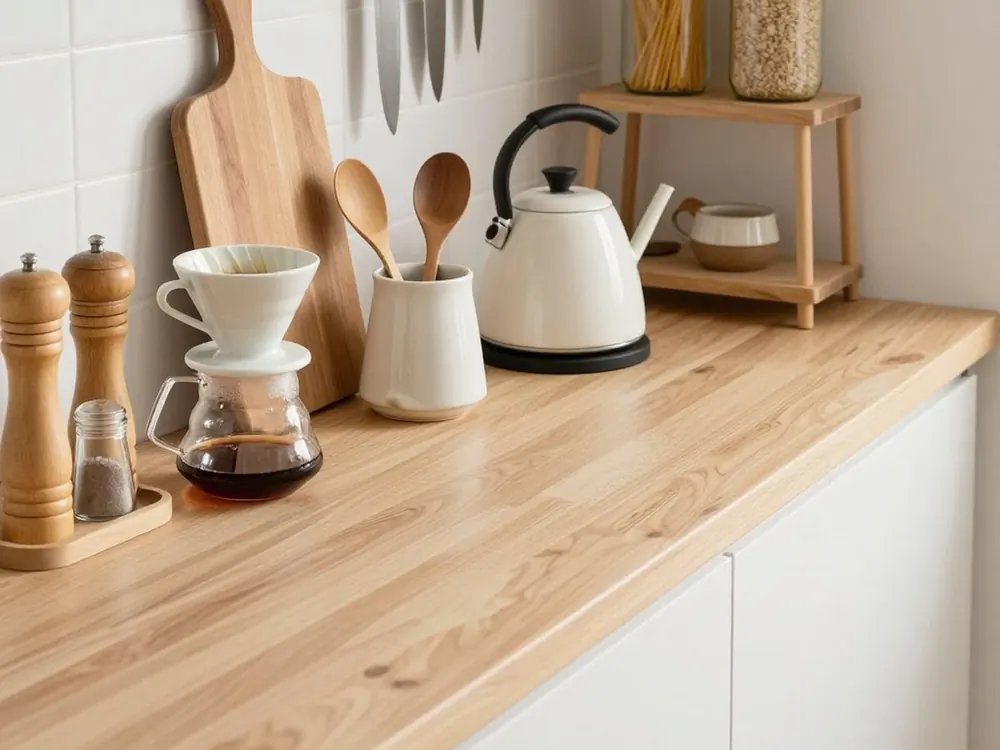
Keep only the things you use every day, which for most people means the coffee maker, a utensil crock, salt and pepper, and possibly a knife block. Everything else goes in a cabinet, on a cart, or out of the kitchen.
Where do I put my microwave if my counter is tiny?
A sturdy rolling cart or a microwave stand with storage underneath takes it off the counter. Check that the shelf's weight rating is higher than your microwave's weight and that the microwave has a few inches of clearance for ventilation.